
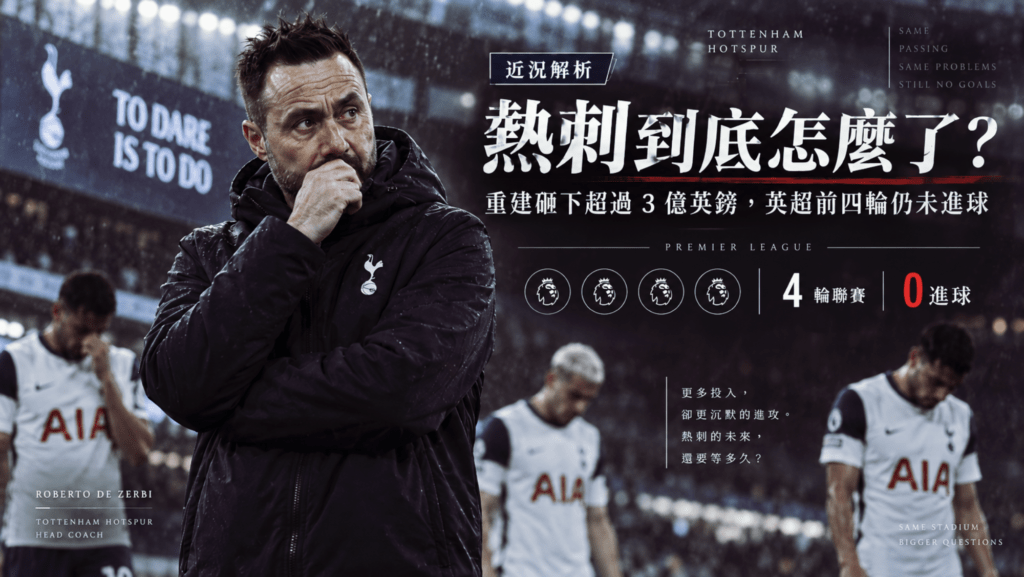
If we only look at the summer transfer window activity, Tottenham Hotspur should have been one of the most anticipated rebuilding teams in the Premier League this season.
Last season they plummeted to the brink of relegation, until... Roberto De Zerbi Only after taking over did they manage to pull the team back to safety in the final stages. The club's management then publicly acknowledged the need for a "complete overhaul," and spent heavily in the summer transfer window, exceeding [amount missing]. £300 million A major overhaul was undertaken. However, after four rounds of the new season, Tottenham not only failed to secure a single victory, but also set an embarrassing record unprecedented in the club's history in the Premier League era:They hadn't scored a single goal in the first four rounds.。
Sports betting: RM Casino
Sports betting: RM Game City
Why can't a major overhaul with huge investments result in goals?
Before the season began, De Zerbi clearly stated that his first priority was to rediscover the "soul of the team." The first team was almost completely reorganized, with the addition of several established players and promising young talents.
- Defense and midfield core: Andy Robertson, Sandro Tonali, Jan Paul van Hecke
- Attacking spearhead in the frontcourt: Mateus Fernandes, Sávio, Omar Marmoush
Despite a completely revamped squad, this star-studded lineup, worth over £300 million, quickly faced a severe test at the start of the season.
The brutal opening four games: from tactical failure to mental collapse
Tottenham's first four games of the season perfectly exposed the gradual deterioration of the team's problems:
1. The gap in physical fitness and physical strength (0-3 defeat away to Brentford)
In the opening match, all four new signings started, but the team was clearly outmatched in terms of physicality, tempo, and formation cohesion. De Zerbi admitted after the match that the team "lost too many physical duels." This is not just a matter of the new lineup not yet gelling, but also a wake-up call for the team's form.
2. Lack of ability to convert dominance into goals (0-2 home defeat to Newcastle)
In the second round, Tottenham actually took the initiative at home, bombarding the entire match. 17 shotsUltimately, they still suffered a defeat. In contrast, Newcastle took two goals with just two shots on target. This match shifted Tottenham's problem from "defensive instability" to a more fatal core issue: the team could create local advantages, but was completely unable to convert those advantages into actual goals.
3. The absence of a finisher in the penalty area (0-0 draw against Nottingham Forest)
Although Tottenham secured their first point of the season in the third round, they were surprisingly...Not a single shot on targetReuters, a foreign media outlet, pointed out the problem with Tottenham's attacking lineup after the match: Tottenham invested heavily but failed to acquire a "true center forward" who could reliably solve problems in the penalty area.
- Omar Marmoush, Sávio, and Mathys Tel possess speed and skill, but they are not finishers who can consistently dominate the penalty area.
- Dominic Solanke is struggling with his condition and injury.
- Richarlison is no longer part of the team's main plans.
In the final third of the attack, the players lacked composure and made repeated mistakes in crossing, overlapping, and finishing the ball.
4. The "psychological barrier" that permeated the entire team (0-0 draw against Everton at home)
In the latest home game, the problem has escalated from a technical to a psychological one. Tottenham finally managed a shot on target, but it was met with sarcastic cheers from the home fans and a deafening chorus of boos at the final whistle.
De Zerbi makes its first public appearance "Mental block" To describe the current situation, the team performed well in the first 30 minutes, but their confidence subsequently crumbled, and their choices before entering the penalty area became increasingly hasty. This is Tottenham's most dangerous sign right now—the players have begun to fear making the wrong decisions.
De Zerbi's tactical blueprint and the wounded soldier dilemma
De Zerbi's football philosophy heavily relies on players making the right judgments under pressure: daring to hold the ball in the backfield, drawing pressure in the midfield, and delivering a decisive pass in the attacking third the moment the defense is stretched out.
Tottenham's current attacking play in the back and midfield is occasionally showing promise, but the finishing touch completely breaks down. Against Forest, Robertson's overlapping run was ignored, and his cross went wide; against Everton, the same attacking blunder occurred again. This indicates that Tottenham isn't entirely without a tactical framework, but rather that while the framework exists, the finishing element is missing.
wave of wounded soldiersThis further exacerbates the already strained scheduling situation:
- MudrykHe had just made his first official match appearance in nearly two years when he injured his ankle during training. Originally considered a key player who could enhance his one-on-one breakthroughs and vertical speed, he went down just as he was beginning to integrate into the team.
- KulusevskiHe remains absent.
- MaddisonAlthough he has recovered from his injury, his form has not yet returned to the level where he can dominate the game.
These injuries have significantly limited De Zerbi's tactical options, further exacerbating the team's already lack of consistent goal-scoring opportunities.
The contradiction between cup competition in full swing and the league mired in difficulties.
Ironically, Tottenham haven't completely lost their scoring ability. In their EFL Cup match against Charlton, they... 5-1 victorySávio came off the bench and contributed a goal and an assist.
This proves that the attacking players have talent, but when the battle is brought back to the Premier League – facing stronger physical confrontations, a tighter penalty area, and a faster pace of transition – Tottenham's attack is instantly paralyzed.CupThat game could create numerous chances once the space was opened up, but the common feature of the four league matches was that the opponents knew exactly how to force Tottenham into slower, more crowded, and more precise positional battles, which was precisely the most immature weakness of this young, rebuilding team.
In conclusion: More important than playing beautifully, Tottenham now simply needs to "goal first."
Therefore, the answer to the question "What exactly is wrong with Tottenham?" is not a single reason.
This isn't because De Zerbi lacked tactics, nor is it because the summer signings were all flops. It's simply because this team...Too many changes were made at once, but what was missing was the lubricant that would allow the rebuilding gears to turn smoothly – "scoring a goal".
A new defense, a new midfield, new wingers, a new coach, and new attacking habits—all of these need time to develop. The cruelest thing about football is that once a striker can score the first goal, many problems suddenly seem less serious; conversely, if a team doesn't score, even the smoothest passing and control, and the most meticulous structure, will be consumed by immense anxiety.
Four games without a goal is no longer just a cold, hard statistic. It has become a huge burden for Tottenham every time they launch an attack.
For De Zerbi, the first real issue to address is no longer how to get Tottenham to play beautiful football, but rather...Try every possible way to get the team to score the first goal.。
🔥Popular articles:Liverpool's Premier League start with 1 win and 3 draws: Wirtz and Isak isolated, highlighting concerns about the Reds' lack of a cohesive system.